
ALCO Bullet Talk #15
An Air Rifle on the American Frontier?
When Lewis and Clark set out to explore the American West in 1804, they carried rifles, supplies, and equipment needed to survive an uncertain journey. But among their weapons was something that might surprise today’s hunters — a powerful air rifle.
America was built on grit, determination, courage, and innovation. Generations of people crossed oceans, explored unfamiliar country, and worked to build a future filled with possibilities. It took people willing to face the unknown, make do with what they had, and find better ways to get things done.
The Lewis and Clark Expedition reflected much of that pioneering spirit. Setting out across an enormous and challenging landscape, the men relied on preparation, resourcefulness, and some remarkable technology for their time.
Among their equipment was something that might surprise today’s hunters — a powerful repeating air rifle.
That’s right. More than 200 years ago, an air rifle accompanied one of the most famous expeditions in American history.
And it wasn’t a toy.
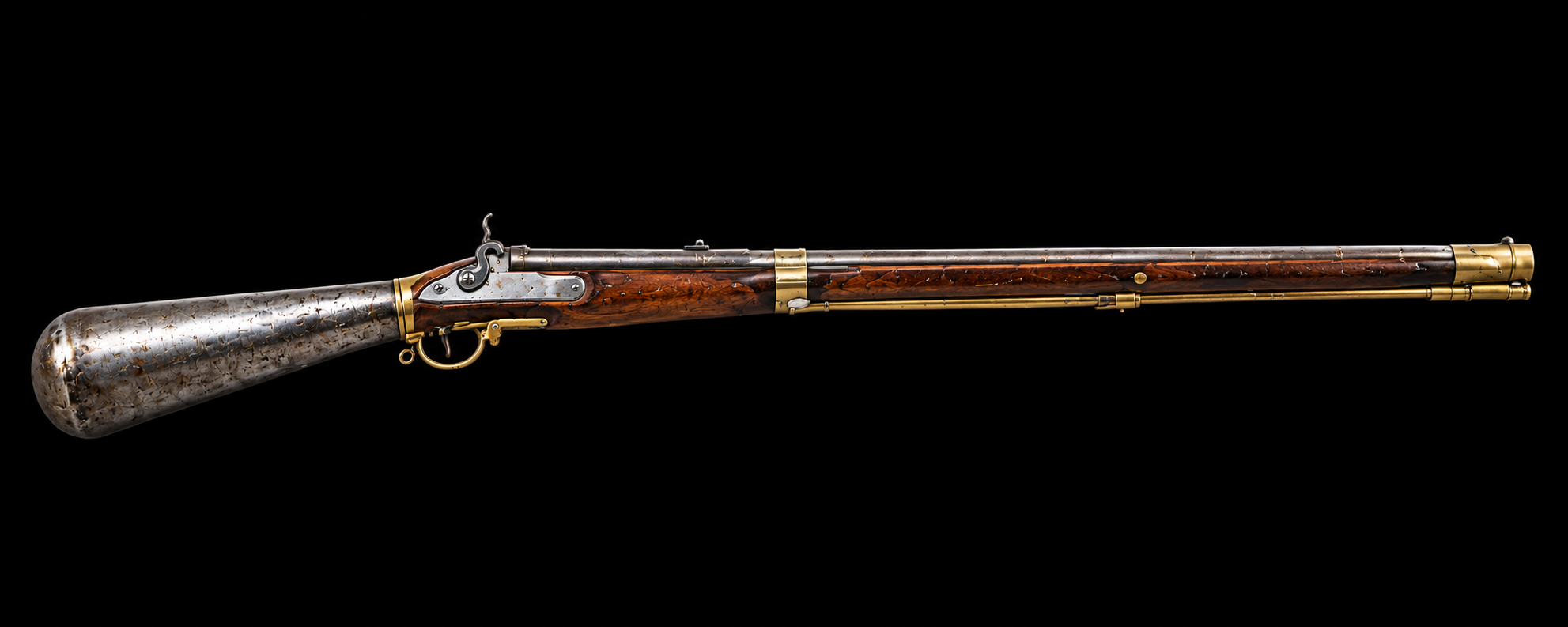
Above is an Illustration of a Girandoni-style repeating air rifle, similar to the type associated with the Lewis and Clark Expedition.
A Remarkable Rifle Ahead of Its Time
Meriwether Lewis purchased an air rifle before the expedition began. Although historians still debate its exact design, it is often associated with the Austrian Girardoni repeating air rifle.
The Girardoni was an extraordinary invention for its time. It fired large lead balls, approximately .46 caliber, using compressed air stored in a reservoir that formed the rifle’s stock.
Unlike the common single-shot firearms of the day, the Girardoni design could fire multiple shots without reloading after every discharge. It required no gunpowder, produced no powder smoke, and offered a capability few people had ever witnessed.
In August 1803, Lewis recorded firing his air rifle seven times at a distance of 55 yards, reporting reasonably good results.
For anyone familiar with today’s big bore PCP airguns, the concept sounds surprisingly familiar.
A Rifle That Commanded Attention
As the expedition traveled west, Lewis demonstrated the air rifle to members of several Native American nations.
The reactions recorded in the expedition journals were remarkable. People were reportedly astonished that a rifle could fire repeatedly without gunpowder.
But the air rifle may have served a purpose beyond demonstrating new technology.
On April 3, 1806, approximately 37 Native American visitors gathered around the expedition’s camp along the Columbia River. According to Clark’s journal, Lewis fired the air rifle, astonishing the visitors and encouraging them to maintain a respectful distance.
Earlier that year, the expedition recorded another interesting observation. After Clatsop visitors witnessed the men’s marksmanship and the air rifle’s capabilities, Lewis suggested that their reputation as skilled shooters might discourage potential hostility.
Could an air rifle have helped protect the expedition without ever being fired in combat?
It’s certainly possible. While historians cannot prove the rifle prevented an attack, the journals make clear that Lewis recognized its ability to command attention.
Interestingly, although firearms were valuable trade goods on the frontier, the expedition retained its unusual air rifle throughout the journey.
From Frontier Air Rifle to Modern Big Bore PCP
Fast-forward more than two centuries, and the basic principle remains the same: compressed air propelling a lead projectile.
But today’s big bore PCP airguns are a world apart from that early invention.
Modern airguns offer improved engineering, precision barrels, sophisticated air systems, and a wide selection of hunting projectiles. Hunters can choose bullet weights, designs, and calibers suited to their particular airgun and intended game.
Where Lewis carried an unusual rifle into largely unfamiliar territory, today’s hunters have the advantage of carefully developed equipment and extensive ballistic knowledge.
Still, one principle hasn’t changed.
Knowing your equipment — and having confidence in its performance — matters when you’re in the field.
The Bullet Still Matters
From the simple round lead balls carried by early explorers to today’s precision-engineered hunting slugs, the projectile has come a long way.
And so has the airgun.
What began with early compressed-air rifles has evolved into today’s powerful big bore PCP airguns, capable of impressive accuracy and serious hunting performance.
But even with all those advances, one thing hasn’t changed — the importance of the bullet.
At ALCO Bullets, we manufacture precision-swaged, 100% soft lead airgun slugs designed for consistent accuracy and dependable hunting performance. From hollow points to our premium tipped designs, we understand that matching the right projectile to the airgun and the hunt matters.
Lewis and Clark could hardly have imagined the airguns hunters carry today. Yet they understood the value of preparation, innovation, and equipment they could depend on.
More than 200 years later, that pioneering spirit lives on.
As a small, family-owned American business, we’re proud to carry forward a tradition of craftsmanship, determination, and the belief that there’s always a better way to get things done.
ALCO Bullets — Accuracy Above All Else.
Every ALCO Bullet Talk article is written to help shooters better understand projectile design, long-range performance, precision manufacturing, and today’s big bore PCP airguns.
Every ALCO bullet is engineered around three performance goals: uncompromising accuracy, superior ballistic efficiency in flight, and dependable terminal ballistics on impact. The engineering principles discussed in this article are applied throughout the entire ALCO airgun slug lineup. Whether you’re looking for long-range target performance, dependable hunting performance, or magazine-compatible airgun slugs, every ALCO projectile is engineered for a specific purpose.
.308 Airgun– Ultra-Low Drag (ULD) steel-tip airgun slugs engineered for maximum ballistic efficiency, long-range accuracy, and hunting performance in single-feed rifles.
.338 Airgun Series – Proprietary Ultra-Low Drag (ULD) steel-tip airgun slugs engineered specifically for custom, single-feed .338 caliber PCP air rifles, delivering exceptional long-range accuracy, aerodynamic efficiency, and hunting performance.
.357 Airgun and ORION Series – Ultra-Low Drag (ULD) steel-tip airgun slugs available in both magazine-compatible and single-feed configurations for exceptional competition and hunting performance.
.452 TETON Series – Ultra-Low Drag (ULD) aluminum-tip airgun slugs engineered for maximum ballistic efficiency, retained energy, and long-range accuracy.
.457 LANCER and TETON Series – Ultra-Low Drag (ULD) aluminum-tip airgun slugs developed for maximum ballistic efficiency, retained energy, and long-range precision.
.457 Slug Series – Magazine-compatible, precision-swaged 100% soft lead airgun slugs developed for outstanding accuracy and dependable hunting performance.
.510 LANCER and TETON Series – Ultra-Low Drag (ULD) aluminum-tip airgun slugs engineered for hunters and long-range shooters seeking maximum ballistic efficiency and retained energy.
.510 Slug Series – Magazine-compatible, precision-swaged 100% soft lead airgun slugs available in hollow point, round nose/hollow back, and Slugger configurations for exceptional accuracy and dependable hunting performance.