
ALCO Bullet Talk #10
Beyond Grain Weight
When choosing an airgun hunting slug, grain weight is often one of the first numbers a shooter looks at. Heavier must mean harder hitting—and harder hitting must mean better for hunting. Right?
Not necessarily.
A good hunting slug has more than one job to do. It has to shoot accurately from your rifle, perform efficiently in flight, arrive with the velocity and energy needed for the shot—and then perform as intended when it reaches the animal.
That last part is terminal ballistics, and it’s an important part of choosing a hunting projectile that can easily get lost in discussions about grain weight, velocity and ballistic coefficient.
So rather than asking whether a heavy or light airgun slug is better, let’s ask a more useful question:
What makes a good airgun hunting slug?
For hunting, the best slug isn’t necessarily the heaviest, the fastest, or the one with the highest ballistic coefficient. It is the projectile that brings several things together.
It needs to shoot accurately from your rifle. It needs enough ballistic efficiency to reach the target with useful velocity and energy. And once it gets there, its terminal ballistics become critical.
A well-designed hunting slug should provide the penetration needed to reach vital areas while transferring energy effectively. Depending on the projectile design and the game being hunted, controlled expansion can increase the wound channel while the remaining projectile continues to penetrate.
That’s why ALCO looks beyond grain weight when designing our big bore airgun slugs. Accuracy, ballistic efficiency and terminal performance all have a job to do—and none of them works alone.
Ultimately, the number on the box tells you how much the slug weighs. It doesn’t tell you the whole story of what that slug can do.
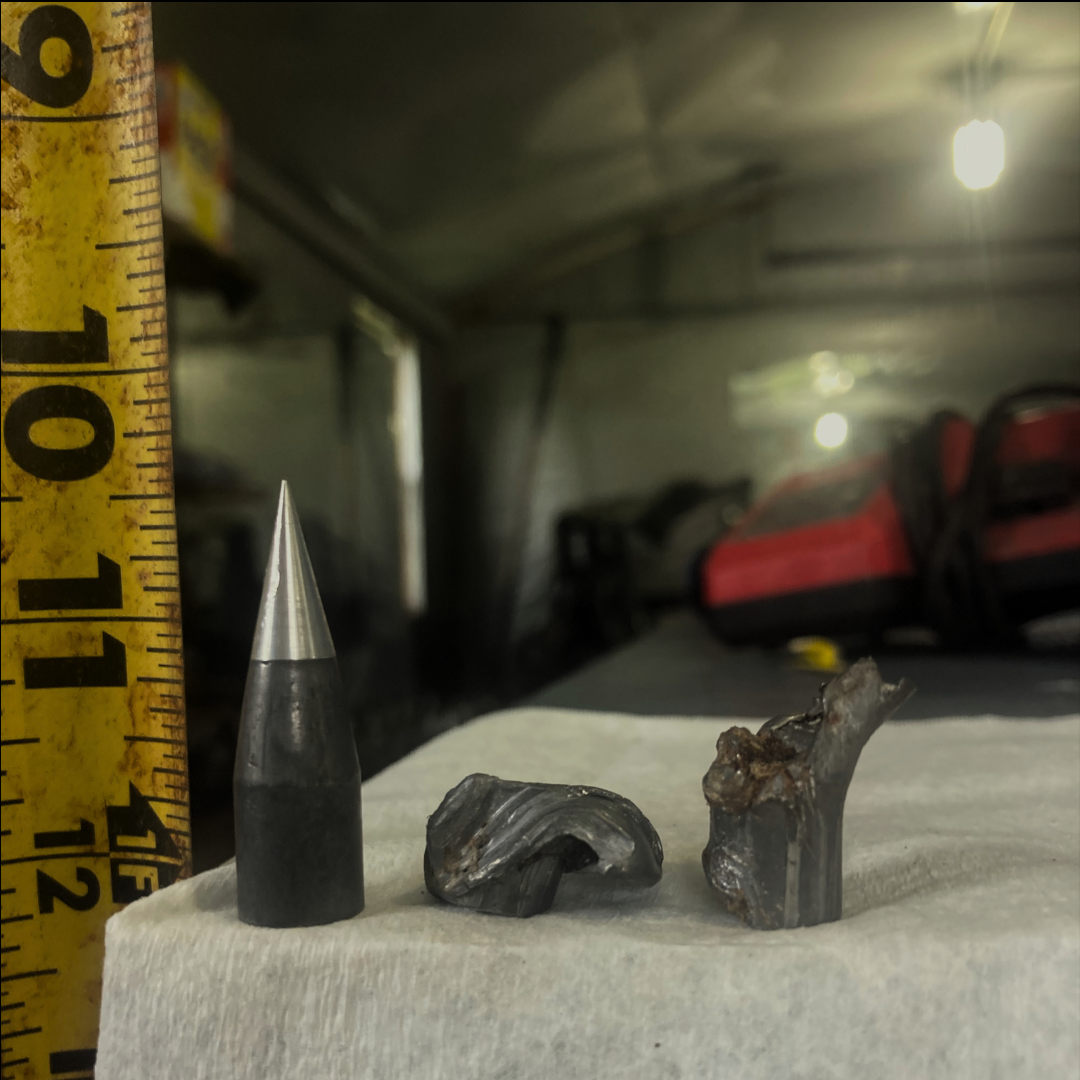
Field-Proven Expansion
The Alco 45 caliber bullets in the photo were recovered from deer harvested by Troy in Florida. The two deformed projectiles on the right show the results after impact. After entering the animal, the tip comes off and the soft lead slug essentially becomes a wide hollow point delivering expansion. The tip provides the accuracy to get good shot placement; the lead deformation makes for a humane result. This offers you a real-world look at expansion after impact.
What You Gain With a Lighter Airgun Slug
Within the same caliber and rifle, a lighter slug will generally leave the muzzle faster than a heavier one when both are fired with the same available power.
That additional velocity can produce a flatter trajectory over practical distances. Less drop can make range estimation somewhat more forgiving and may simplify holdovers.
A lighter slug can also be a better match for an air rifle that simply does not have enough power to launch a much heavier projectile at the velocity needed for good performance.
But velocity alone doesn’t determine what happens farther downrange.
A projectile that starts faster but loses velocity quickly may give up much of its initial advantage as distance increases.
What You Gain With a Heavier Airgun Slug
Heavier slugs have the potential to carry substantial energy and momentum downrange. When combined with an efficient projectile shape and appropriate velocity, they can be excellent choices for hunting and longer-range shooting.
Heavier projectiles can also offer advantages in the wind—but weight alone does not determine wind drift. Projectile shape, ballistic coefficient, velocity and atmospheric conditions all play a part.
This is why comparing two slugs based only on grain weight can be misleading.
A well-designed lighter slug may outperform a heavier, less aerodynamically efficient projectile. Likewise, a beautifully designed heavy slug cannot deliver its potential if the rifle cannot launch and stabilize it properly.
The Trade-Off: Your Air Rifle Has to Drive It
There is no free performance.
As slug weight increases, the rifle has more mass to accelerate. A powerful PCP may handle that easily. Another rifle may produce substantially lower velocity with the same heavy projectile.
Go too heavy for the rifle, and trajectory can become increasingly arched. More importantly, accuracy may suffer if the rifle and barrel are simply not well matched to that particular slug.
That is why the question shouldn’t be:
“What’s the heaviest slug my rifle can shoot?”
A better question is:
“Which slug does my rifle shoot consistently and accurately for what I want to accomplish?”
Hunting Adds Another Consideration — Terminal Ballistics
For hunting, getting the slug to the target accurately is only part of the job. What the projectile does when it arrives matters just as much.
This is where terminal ballistics comes into the discussion. A good hunting slug needs to deliver predictable performance on impact. Depending on its design, that can mean controlled expansion, effective energy transfer and sufficient penetration to reach vital areas.
This is also why grain weight alone doesn’t tell you whether one airgun slug is a better hunting choice than another. A heavier slug may carry more momentum and energy, but if its construction isn’t designed to use that energy effectively on impact, additional weight by itself doesn’t guarantee better terminal performance.
At ALCO, we design our hunting slugs with the entire flight and impact in mind. Our soft swaged lead, hollow-point designs, deep cavities and other projectile configurations are developed for different performance goals. Our tipped ULD designs take that thinking a step further by combining aerodynamic efficiency in flight with purposeful terminal performance.
The goal isn’t simply to make the heaviest or fastest airgun slug possible. It is to build a projectile that flies accurately, retains useful performance downrange and does its job when it reaches the target.
For the hunter, that complete performance matters far more than the grain weight printed on the box.
Find the Combination Your Rifle Likes
If your air rifle can shoot several slug weights, test them rather than assuming heavier or lighter will be better.
Shoot groups at your normal zero distance. Then move farther out. Record velocity if you have a chronograph, and pay attention to group size, point of impact and consistency throughout the rifle’s usable pressure range.
The target will tell you far more than grain weight alone.
The Bottom Line
Heavy vs. light airgun slugs isn’t really a contest between more weight and more speed.
It is about balance.
For a hunter, accuracy gets the slug where it needs to go. Good terminal ballistics determine what happens when it gets there.
Beyond Grain Weight
So, what makes a good airgun hunting slug?
There isn’t one grain weight—or one number—that provides the answer.
Your rifle has to launch it well. The slug has to fly accurately and efficiently, retain useful performance to the target, and for hunting, still have one final job to do when it gets there.
That’s why choosing an airgun hunting slug means looking beyond the number on the box.
Accuracy gets the slug where it needs to go. Good terminal ballistics determine what happens when it gets there.
And ultimately, that’s what matters in the field.
Explore the ALCO Airgun Slug Lineup
The engineering principles discussed in this article are applied throughout the ALCO airgun slug lineup. Whether you’re looking for long-range target performance, dependable hunting performance, or magazine-compatible airgun slugs, every ALCO projectile is engineered for a specific purpose.
Built to Compete. Proven to Hunt.
.308 Airgun– Ultra-Low Drag (ULD) steel-tip airgun slugs engineered for maximum ballistic efficiency, long-range accuracy, and hunting performance in single-feed rifles.
.338 Airgun Series – Proprietary Ultra-Low Drag (ULD) steel-tip airgun slugs engineered specifically for custom, single-feed .338 caliber PCP air rifles, delivering exceptional long-range accuracy, aerodynamic efficiency, and hunting performance.
.357 Airgun and ORION Series – Ultra-Low Drag (ULD) steel-tip airgun slugs available in both magazine-compatible and single-feed configurations for exceptional competition and hunting performance.
.452 TETON Series – Ultra-Low Drag (ULD) aluminum-tip airgun slugs engineered for maximum ballistic efficiency, retained energy, and long-range accuracy.
.457 LANCER and TETON Series – Ultra-Low Drag (ULD) aluminum-tip airgun slugs developed for maximum ballistic efficiency, retained energy, and long-range precision.
.457 Slug Series – Magazine-compatible, precision-swaged 100% soft lead airgun slugs developed for outstanding accuracy and dependable hunting performance.
.510 LANCER and TETON Series – Ultra-Low Drag (ULD) aluminum-tip airgun slugs engineered for hunters and long-range shooters seeking maximum ballistic efficiency and retained energy.
.510 Slug Series – Magazine-compatible, precision-swaged 100% soft lead airgun slugs available in hollow point, round nose/hollow back, and Slugger configurations for exceptional accuracy and dependable hunting performance.