
ALCO Bullet Talk #2
How Fast Can I Push It
One of the most common questions we hear from shooters is:
“How fast can I push it?”
Speed in the airgun world is a different ball game. When it comes to modern big bore airguns and precision airgun slugs, speed is only part of the equation. This is also one of the most confusing things for airgunners to consider, especially when comparing air rifles to centerfire rifles.
Centerfire rifles and airguns may both send a projectile down a barrel, but they do it in very different ways. A centerfire rifle uses burning powder to create rapidly expanding gas. That combustion event can produce extremely high chamber pressure — often approaching 60,000 psi in modern rifle cartridges. That pressure spike is what allows centerfire rifles to drive bullets at supersonic velocities.
An air rifle does not work that way.
A PCP airgun uses stored compressed air. There is no powder burn, no combustion event, and no explosive pressure spike. When the valve opens, compressed air is released behind the slug and begins pushing it down the barrel. As the slug moves forward, the space behind it increases and the pressure begins to fall.
That difference matters.
Most airgun barrels and systems are not built like centerfire rifle barrels and actions. They are designed around compressed air, not the extreme pressures created by burning rifle powder. Many airgun barrel systems use lighter materials and different construction methods, and they are not intended to contain centerfire-level pressure. That is one reason big bore airguns live in a very different velocity range than rifles. Before we talk about velocity, let’s look at how a centerfire rifle and a PCP airgun produce pressure.
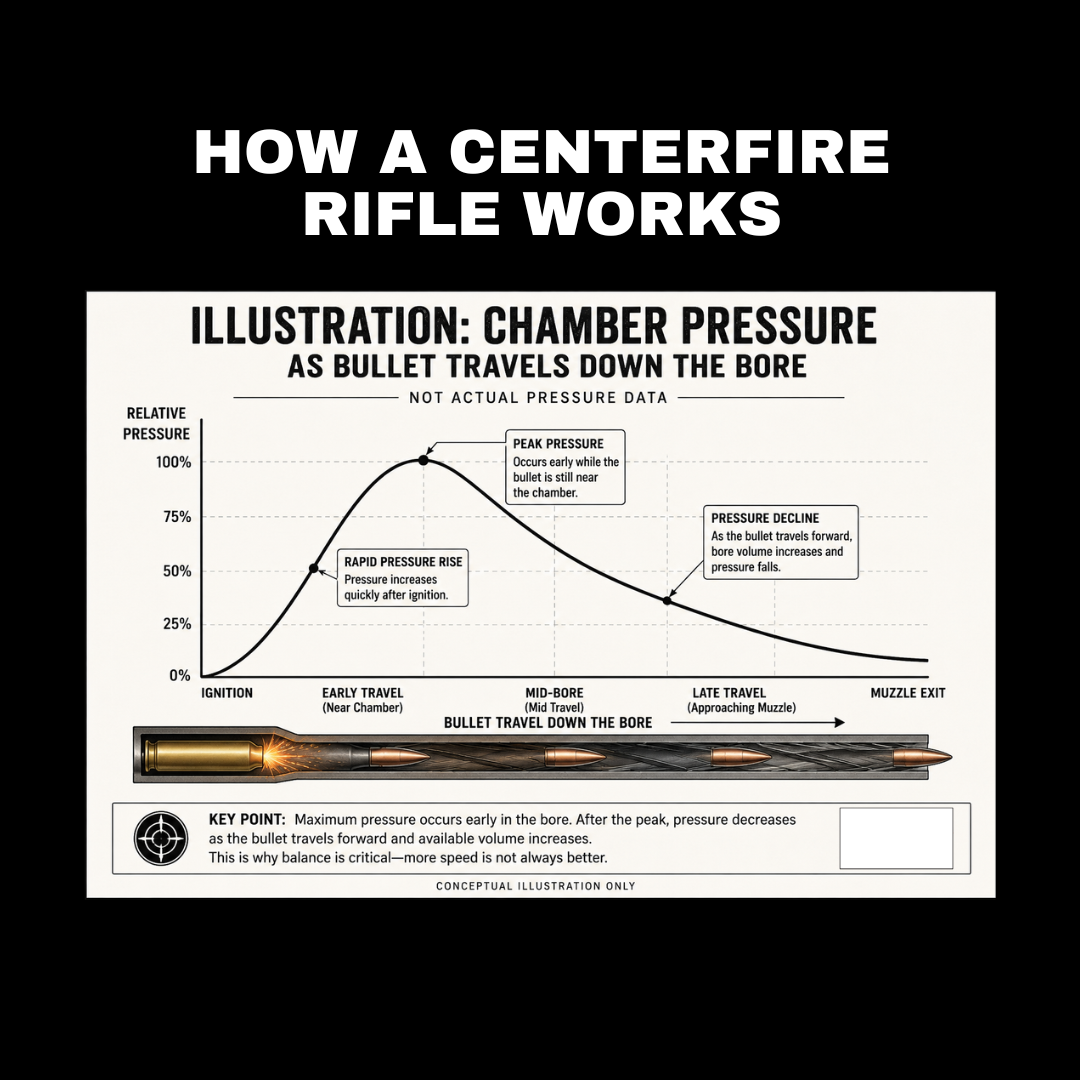
- Sharp pressure spike
- Rapid decline
Figure 1. Conceptual centerfire rifle pressure profile. Chamber pressure rises rapidly after ignition, peaks early in bullet travel, then declines as the bullet moves down the bore. Illustration only—not actual pressure data.
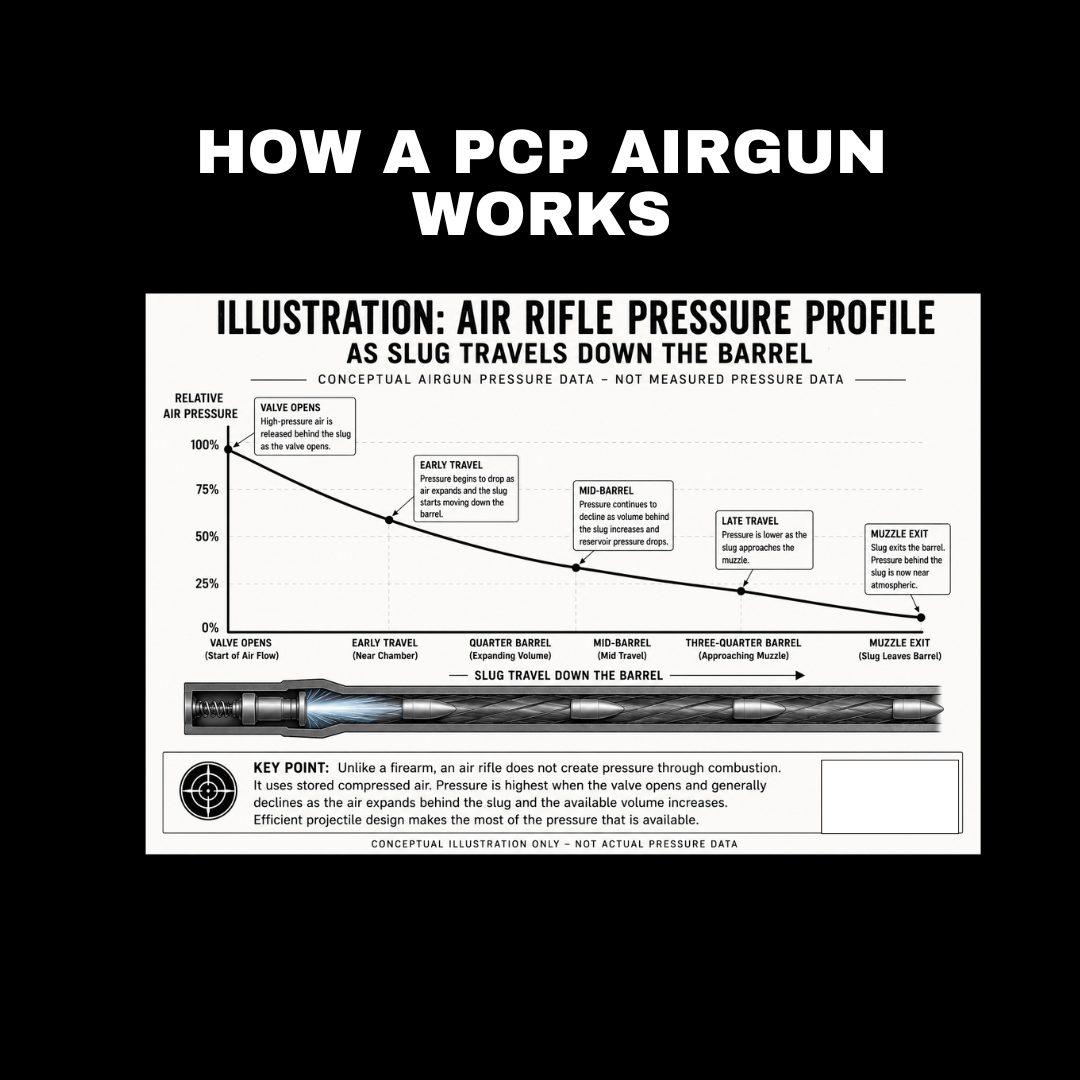
- Smooth declining pressure curve
- Pressure comes from stored compressed air, not combustion
Figure 2. Conceptual PCP airgun pressure profile. Stored compressed air is released behind the slug when the valve opens. Pressure rapidly decreases as the slug travels down the barrel and the air expands. Illustration only—not measured pressure data.
Both systems propel a projectile down the bore, but by very different mechanisms. A firearm creates pressure through rapidly expanding combustion gases. A PCP airgun releases stored compressed air. Understanding that difference helps explain why chasing ever-higher velocity is often less important in airguns than efficient projectile design.
That is where efficiency comes in. A well-designed airgun slug does not need rifle velocity to perform well. It needs to seal properly, stabilize correctly, carry energy efficiently, and make the most of the pressure available. That is the real game in big bore airguns.
“How fast can I make this slug?”
The better question is:
“How efficiently can this slug use the energy available?”
Imagine two projectiles.
One leaves the muzzle slightly faster but has a blunt profile that creates significant drag. It slows rapidly and sheds energy throughout its flight.
The second begins slightly slower but has a more aerodynamic profile. It encounters less drag, retains velocity longer, carries more energy downrange, and remains stable throughout its flight.
Which one performs better? The goal is to deliver useful energy accurately to the target.
Efficiency wins.
Good Design Makes Good Ballistics
This philosophy guides ALCO projectile development from the beginning.
Long before designing airgun slugs, we focused on precision rifle bullets where aerodynamic efficiency has always been one of the foundations of long-range accuracy.
Those same engineering principles apply to airguns.
Every curve of the nose, every transition in the ogive, every bearing surface, and every manufacturing step influences how efficiently a projectile moves through the air.
When drag is reduced, several good things happen:
- Velocity is retained longer.
- More energy reaches the target.
- Wind drift is reduced.
- Flight remains more consistent.
- Accuracy improves.
Ballistic coefficient often receives most of the attention, but BC is really the result of good design—not the design goal itself.
That’s why ALCO begins every new projectile with aerodynamic efficiency rather than simply chasing larger BC numbers.
Performance Doesn’t End at Impact
Efficient flight is only half of the equation.
A hunting slug must also perform after it reaches its target.
This is one reason ALCO has invested heavily in tipped projectile designs such as the ORION, LANCER, and TETON series.
The CNC-machined tip helps initiate expansion upon impact. As the tip separates, it creates a hollow-point effect while the soft lead core continues penetrating through the target. The result is controlled energy transfer designed for ethical hunting performance.
Once again, the objective isn’t maximum velocity.
It’s dependable performance.
Accuracy Is Still King
Modern PCP air rifles have changed what airgunners can accomplish. Today’s rifles are capable of remarkable precision while launching .308, .357, .457, and .510 caliber airgun slugs with authority.
As equipment has improved, projectile design has become more important than ever.
Many shooters search for airgun slugs, airgun bullets, airgun pellets, or big bore PCP projectiles naturally compare velocity numbers first.
But velocity alone doesn’t tell the story.
A consistent projectile with excellent balance, efficient aerodynamics, and reliable terminal performance will almost always inspire greater confidence than one built simply to produce higher chronograph readings.
Hunters have known this for generations.
Shot placement matters.
Consistency matters.
Projectile design matters.
Velocity certainly has its place, but it should never become the only goal.
Because at the end of the day, success isn’t measured by how fast a slug leaves the muzzle.
It’s measured by what it accomplishes when it gets there.
Built to Compete. Proven to Hunt.